Stalin's Death and the Soviet Succession Crisis
A Gentleman in MoscowJoseph Stalin’s death on 3 March 1953 transformed the problem of political authority into an immediate succession crisis: no successor had been designated, and eight figures within the Presidium could plausibly claim the right to lead. The public funeral revealed the varied meanings attached to Stalin’s rule, while the political settlement that followed rejected the concentration of top offices in one person and left authority divided between Malenkov and Nikita Khrushchev.
Historical Background
The episode belongs to a wider account of political change in which the scale of a turning point is often clearest only in retrospect. The narrative describes historians identifying consequential dates from the comfort of hindsight, then points to transformations already reshaping the Soviet state: the launch of the First Five-Year Plan in 1928, the removal of Bukharin from the Politburo in 1929, and the drafting of Article 58 of the Soviet Criminal Code in 1927. These developments are not presented as direct causes of Joseph Stalin’s death. They establish a political landscape marked by industrial ambition, concentrated authority, and a widening capacity to classify and constrain people.
The First Five-Year Plan placed heavy demands on agricultural regions, which were expected to supply more grain as urban industry expanded. The policy drive to exile a million kulaks removed many of the regions’ most capable farmers; other peasants resisted new agricultural methods, tractors remained scarce, and poor weather compounded the decline in output. Despite falling harvests, authorities raised requisition quotas and enforced them at gunpoint. In 1932, these pressures brought widespread hardship and starvation to millions of peasants in Ukraine. This background gives the succession crisis a particular weight: it followed decades in which state plans and political decisions had reached deep into ordinary life, even as the future direction of the government remained unsettled.
Death and Public Mourning
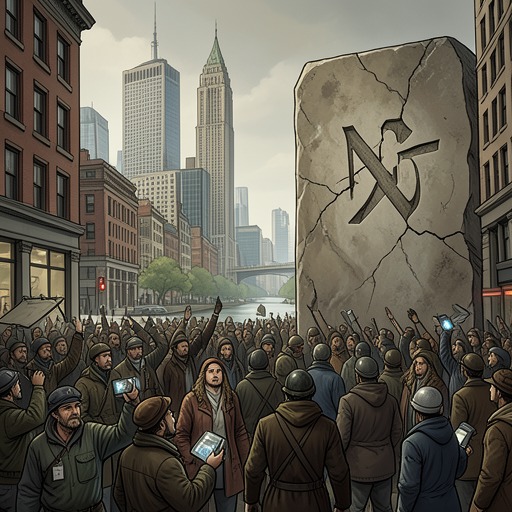
Joseph Stalin died at his residence in Kuntsevo in the aftermath of a stroke. The following day, workmen and trucks carrying flowers arrived at the Palace of Unions on Theatre Square. Within hours, the building’s façade bore a portrait of Stalin three stories high. The public staging of grief was large in scale, but the narrative resists treating those who came to mourn as a single, easily explained crowd.
On 6 March, Harrison Salisbury, the new Moscow bureau chief of The New York Times, watched from rooms once occupied by the Count and then used by the Mexican chargé d’affaires as members of the Presidium arrived in ZIM limousines. Stalin’s coffin was carried in from a bright blue ambulance. When the Palace of Unions opened to the public on 7 March, the line of citizens waiting to pay their respects stretched five miles across the city. More than a million people stood in line. Some mourned the leader associated with victory in the Great Patriotic War; others mourned the man credited with driving Russia toward world-power status; still others faced the loss as the beginning of an uncertain era. The length of the queue registers the scale of the moment, but the different reasons for grieving prevent that scale from becoming a simple measure of political loyalty.
The Succession Crisis
Joseph Stalin’s death left no plan of succession and no obvious designee. Within the Presidium, eight men could reasonably claim leadership: Beria, Minister of Security; Bulganin, Minister of the Armed Forces; Malenkov, Deputy Chairman of the Council of Ministers; Mikoyan, Minister of Foreign Trade; Molotov, Foreign Minister; Secretariat members Kaganovich and Voroshilov; and Nikita Khrushchev, formerly the mayor of Moscow. The list makes the institutional vacuum concrete. Authority did not pass automatically to a named heir; it was contested among figures already positioned within the state’s upper ranks.
In the immediate aftermath of the funeral, Malenkov seemed the likeliest candidate to prevail. He was a progressive internationalist and an outspoken critic of nuclear arms, and, like Joseph Stalin, he held both the premiership and the position of General Secretary of the Central Committee. That combination appeared to offer a clear center of power, but it also revived the problem of concentrating both offices in one person. A consensus quickly formed among the Party’s senior ranks that this should not happen again.
The New Balance of Power
Ten days after the funeral, Malenkov was forced to pass his chairmanship of the Secretariat to the conservative Khrushchev. The change did not establish an uncontested successor; it divided authority between two men of opposing views and uncertain alliances. Their duumvirate provided a provisional answer to the immediate vacancy while preserving instability at the top. The leadership arrangement kept the wider world guessing for the next few years, and the episode’s emphasis falls less on a clean transfer than on the fragile balance assembled in the absence of an agreed succession.
Political Order and Narrative Form
The account sets this crisis beside smaller systems for making people and actions administratively legible. At the Boyarsky, new procedures required an order to pass from waiter to bookkeeper, ledger, kitchen slip, cooking log, confirmation slip, stamped receipt, and finally the table. Each stage recorded that the previous one had occurred. The procedure made a meal traceable through paperwork; it also displaced the direct, attentive service customers had come to expect. The comparison does not make restaurant administration a cause of the succession crisis. Instead, it places political change within a recurring concern with how institutions organize human activity through records, rules, and chains of authorization.
The hotel’s files offer a more unsettling version of the same impulse to record. Alongside operational reports on revenue, occupancy, staffing, maintenance, and inventories, cabinets held individual files on guests and staff members, including Arkady, Vasily, Andrey, Emile, and Marina. The staff dossiers collected instances of tardiness, impertinence, disaffection, drunkenness, sloth, and desire. The narrative observes that these flaws were not necessarily invented, but that a file could not account for the virtues of the person it reduced to them. Read alongside the succession struggle, these episodes sharpen the contrast between orderly administrative records and the unruly human motives they cannot settle. Joseph Stalin’s death is a decisive political break, but the story presents its consequences not as the execution of a prepared plan: the state has no designated heir, its leading figures compete over the shape of authority, and the resulting settlement remains provisional.